

Architecture & World School · · 12 min read
What is the fastest way to tell architectural styles apart from the sidewalk?
On this page
- Three structural questions that decode any facade
- Comparing classical, medieval, and modern styles
- Master lookup table: all 38 World School units (114 lessons)
- Sacred gates, mortarless castles, and hidden counterweights
- How local ordering and outdoor catch missions work
- World School and city-set taxonomy specification
- Try four live World School sidewalk questions
- Architecture field-spotting questions
Three structural questions that decode any facade
Standing in front of an unfamiliar church, guildhall, or railway terminal, most plaques bury you in royal marriages and restoration dates without explaining what your eyes are looking at. Architectural history gets much simpler on foot when you ignore dates for ten seconds and ask how the builder kept the roof from falling into the street.
Every stone, brick, timber, or steel landmark answers three physical problems: how to span an opening over a doorway or window without snapping the beam, how to keep heavy ceilings from pushing outer walls outward, and how to shed rain, snow, or harsh sun off the facade. Once you spot those load paths, style names stop feeling like museum jargon and turn into visible engineering fingerprints you can read from across the crosswalk.
Pandabout's World School distills those visual rules into 38 pocket units (114 one-minute lessons guided by Panko) drawn directly from the 31,282 landmarks in the catalog. Ten units cover cross-building architectural styles from Romanesque to Brutalism, while twenty-eight units cover specific building and terrain types from Shinto shrines and mortarless Japanese castles to bascule bridges, observatories, and skyscrapers.
Read our deep field note on spotting Gothic architecture
Pandabout's World School ships 114 visual sidewalk lessons across 38 units (10 architectural styles and 28 building and landmark types), backed by 4,001 themed city sets across 1,303 cities and 31,079 Wikidata-verified landmark records.
Comparing classical, medieval, and modern styles
Trace Western and Mediterranean streetscapes in chronological order and each movement reacts directly to the limits of the one before it. Ancient Greek temples stacked upright columns beneath flat stone beams (post-and-lintel), forcing close column spacing because marble cracks in tension over wide gaps. Roman builders switched to true semicircular arches and graded concrete, opening the tiered arcades of the Colosseum and the 43.3-meter unreinforced dome of the Roman Pantheon. Early medieval Romanesque masons inherited that half-circle arch alongside thick fortress-like walls and narrow windows, until twelfth-century Gothic builders pointed the arch upward and moved wall bracing outside onto flying buttresses so naves could glow with stained glass.
Three centuries later in Florence and Rome, Renaissance architects rejected medieval verticality for calm, flat, mathematically proportioned stone bays, rusticated ground floors, and round arches, as seen down the river arch of Piazzale degli Uffizi. Seventeenth-century Baroque builders took that exact classical vocabulary and bent it into motion: curving church walls like stage curtains, splitting pediments open, and twisting columns upward. Eighteenth- and nineteenth-century Neoclassical architects stripped those curves back out, placing straight colonnades under crisp triangular temple pediments on museums, courts, and parliaments from Paris's Panthéon to London's British Museum.
Industrial iron, reinforced concrete, and elevator frames split modern streets into three unmistakable silhouettes. Around 1890 to 1910, Art Nouveau bent iron balconies and stone ribs into plant stems and waves where a straightedge ruler fits nowhere. In the 1920s and 1930s, Art Deco celebrated machine geometry with stepped skyscraper setbacks, chevrons, and brass sunbursts across Midtown New York. Postwar Brutalism stripped away applied ornament altogether, exposing unpainted board-formed concrete that wears the grain of its wooden molds and lifting pedestrian walkways onto elevated decks like London's Barbican Estate.
Walk Rome's Ancient, Renaissance, and Baroque sets · Walk New York's Art Deco and skyscraper canyons
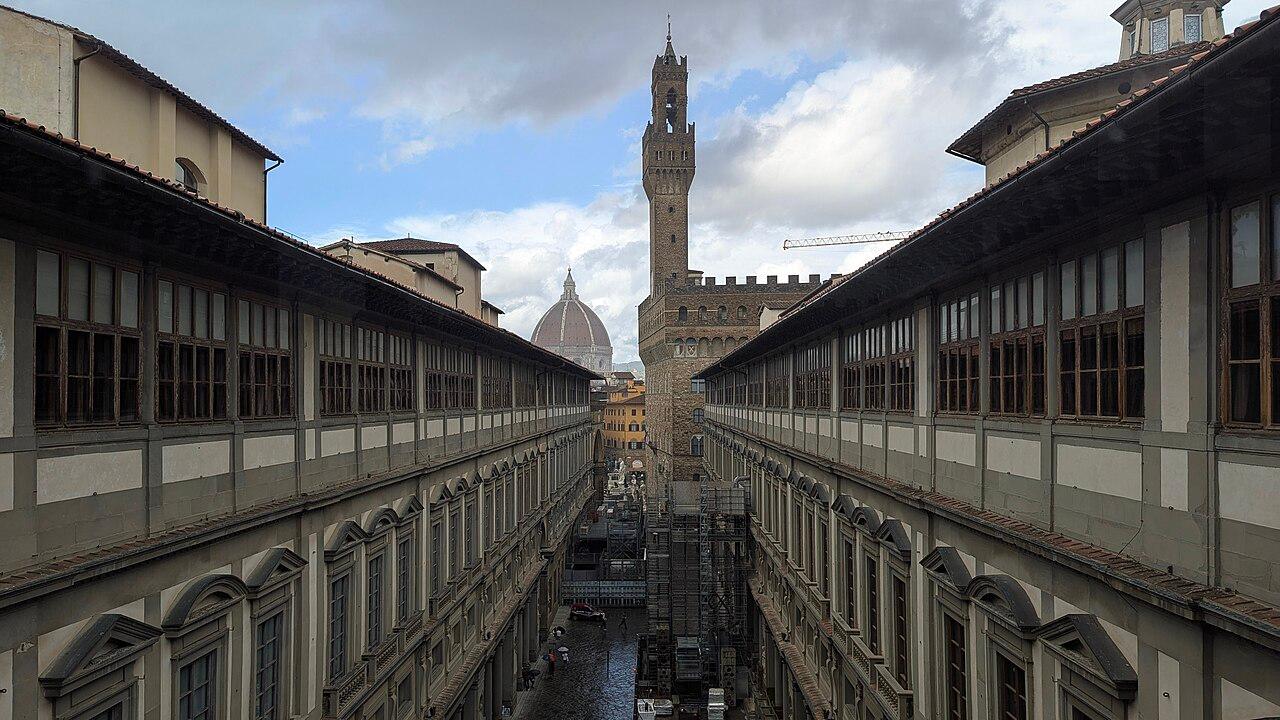 Renaissance · Symmetry + Round Arch · NW 315°
Piazzale degli Uffizi Serliana Arch
Vasari's Uffizi river loggia pairs flat Doric entablature bays with a central semicircular arch in textbook Renaissance symmetry.
Photo: Verum3414 · Wikimedia Commons (CC BY 4.0)
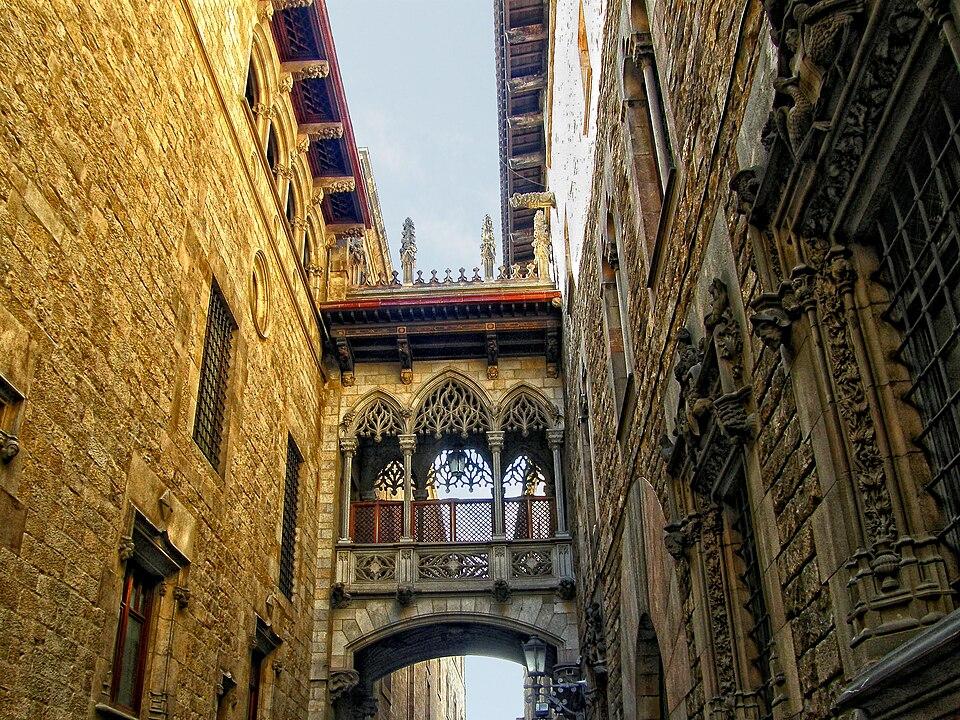 Gothic Revival · Pointed Arch + Tracery · S 187°
Carrer del Bisbe Pointed-Arch Skybridge
1928 Gothic Revival stone bridge by Joan Rubió showing pointed lancet tracery vs medieval load-bearing masonry.
Photo: Andrei Dan Suciu · Wikimedia Commons (CC BY 3.0)
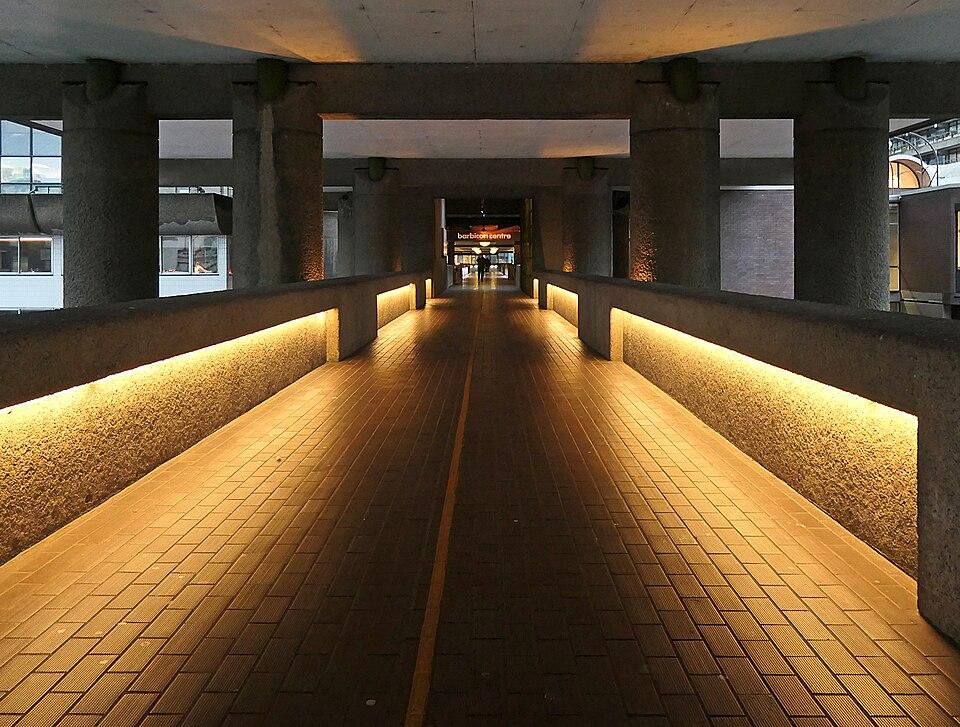 Brutalist · Raw Concrete + Pedway · NW 314°
Barbican Gilbert Bridge Concrete Highwalk
Unpainted bush-hammered concrete and elevated pedestrian decks separate walkers from cars across London's Barbican.
Photo: Amanda Slater · Wikimedia Commons (CC BY-SA 2.0)
Sidewalk structural anatomy · World School (38 units · 114 lessons)
Four structural clues that separate styles in ten seconds


Master lookup table: all 38 World School units (114 lessons)
Use the two tables below as a complete sidewalk reference. First, the eight-row comparison table groups major stylistic families by arch geometry and load-bearing mechanics; directly beneath it, Parts A and B list every single one of the 38 World School units shipped in Pandabout's school.json bundle with its 10-second visual clue, structural explanation, and real catalog examples you can catch in person.
| Feature | Arch & window shape | How the wall carries weight | Instant sidewalk giveaway |
|---|---|---|---|
| Ancient Greek & Neoclassical | Flat stone lintels & rectangular bays | Upright fluted columns + entablature | Triangular temple pediment above straight columns |
| Ancient Roman & Romanesque | Semicircular half-circle round arches | Thick continuous masonry & concrete piers | Deep-set small windows punched into heavy walls |
| Gothic & Gothic Revival | Pointed lancets & petal rose tracery | Exterior flying buttresses + rib vaults | Stone flyers leaping outside stained-glass walls |
| Byzantine & Ottoman / Islamic | Round, horseshoe, or pointed arcades | Spherical pendentives under central dome | High central dome + minarets or 8-pointed stars |
| Renaissance | Evenly spaced round arches & pediments | Rusticated ground stone + ashlar upper floors | Calm, flat mirror symmetry + projecting cornice |
| Baroque & Rococo | Oval domes & split/broken pediments | Undulating masonry + paired pilasters | Curving theater-curtain walls & twisted columns |
| Art Nouveau (1890 to 1910) | Asymmetric bowed glass & arched portals | Exposed wrought iron, steel & stone ribs | Zero straight lines: plant stems, vines & mosaics |
| Art Deco vs Brutalist (1920s to 1970s) | Vertical strip setbacks vs recessed ribbons | Steel frame terracotta vs raw beton brut | Brass zigzags/sunbursts vs bare concrete highwalks |
| Style unit | 10-second sidewalk clue | Structural reason | Catalog examples |
|---|---|---|---|
| Romanesque | Thick stone walls, small windows, and semicircular round arches. | Half-circle arches lock height to half the span width, requiring heavy continuous walls to hold barrel vaults. | Tower of London White Tower, Pisa Cathedral |
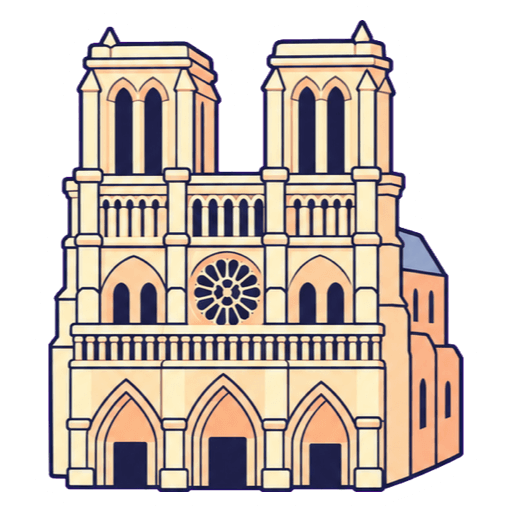
| Gothic | Pointed arches, exterior flying buttresses, and tall stained glass. | Pointed arches reach uniform ceiling heights across uneven bay widths while outer flyers absorb lateral roof push. | Notre-Dame Cathedral, Sainte-Chapelle, Westminster Abbey |
| Renaissance | Flat symmetrical fronts, even column rows, and round arches. | Revives Roman semicircular arches, hemispherical domes, and mathematical bay ratios across calm horizontal stone. | Uffizi Gallery, St. Peter's Basilica dome, Palazzo Farnese |
| Baroque and Rococo | Curving walls, broken pediments, twisted columns, and rich carving. | Undulating stone fronts and corkscrew Solomonic columns pull light and shadow into theatrical upward motion. | Trevi Fountain, St. Paul's Cathedral, Piazza Navona |
| Neoclassical | Straight classical columns supporting a crisp triangular pediment. | Adapts Greek and Roman temple porticoes for civic halls, museums, and arches to signal institutional permanence. | Panthéon (Paris), British Museum, Brandenburg Gate |
| Byzantine | Broad central dome over a square hall with round arches. | Curved spherical triangles called pendentives transfer circular dome weight down onto four corner piers. | Hagia Sophia, St Mark's Basilica |
| Islamic architecture | Interlocking geometric stars, horseshoe or pointed arches, and tilework. | Rotating one square 45 degrees over an identical square generates the recurring 8-pointed star khatam pattern. | Blue Mosque, Alhambra, Al-Azhar Mosque |
| Art Nouveau | Curving lines shaped like plant stems, vines, and flower petals. | Bends wrought iron, glass, and glazed ceramic into asymmetric botanical curves that reject straight rulers (1890 to 1910). | Casa Batlló, Sagrada Família, Paris Metro Hector Guimard portals |
| Art Deco | Stepped setbacks, geometric zigzags, chevrons, and sunbursts. | Pairs 1920s steel skyscraper zoning setbacks with crisp machine-age vertical fluting, brass, and terracotta. | Empire State Building, Chrysler Building, Rockefeller Center |
| Brutalist | Bare, unpainted concrete blocks and elevated walkways. | Leaves raw beton brut concrete exposed with visible wooden shuttering grain and separates pedestrian decks from street traffic. | Barbican Estate, Royal National Theatre (London) |
| Building / sight unit | 10-second sidewalk clue | How it works | Catalog examples |
|---|---|---|---|
| Ancient Greece | Fluted stone columns holding flat horizontal stone beams. | Post-and-lintel construction carries marble roof weight straight down through Doric, Ionic, or Corinthian shafts. | Parthenon, Erechtheion (Athens) |
| Ancient Rome | Massive concrete-and-stone walls pierced by tiered round arches. | True voussoir arches and graded volcanic pozzolana concrete span wide arenas, aqueducts, and unreinforced domes. | Colosseum, Roman Pantheon, Roman Forum |
| Pyramids | Wide four-sided base tapering inward to a high apex or platform. | Stepping or sloping masonry inward keeps the center of mass low so stone courses resist outward collapse for millennia. | Great Pyramid of Giza, Pyramid of Cestius (Rome) |
| Archaeological sites | Excavated wall foundations, broken column drums, or ancient paving. | Preserves layered street plans, stone footings, or worked tool scatters where upper timber and roof structures vanished. | Pompeii, Roman Forum, Baths of Caracalla |
| Castles | High battlemented curtain walls, twin-towered gatehouses, and arrow slits. | Fortified residences combine thick stone walls, moats blocking sappers, and slits flared wide inside for archer aim. | Tower of London, Edinburgh Castle, Nijō Castle |
| Japanese castles | Fan-curved dry-laid granite stone bases topped by white timber keeps. | Mortarless ishigaki stone slopes let interlocking boulders settle slightly and drain rainwater during earthquakes. | Edo Castle (Tokyo Imperial Palace), Nijō Castle |
| Forts | Low, thick angled earthen-and-stone bastions behind a wide dry or wet ditch. | Artillery-era star forts dropped wall profiles low to absorb cannonballs and widened ditches to halt infantry scaling. | Castle Clinton (New York), Castel Sant'Angelo bastions |
| Walls and gates | Fortified civic gateways and projecting perimeter wall towers. | Towers project forward from the curtain line so defenders can see and enfilade the outer face of the wall on both sides. | Porte Saint-Denis, Aurelian Walls (Rome), Kaminarimon |
| Palaces | Long symmetrical wings, tall reception windows, and open forecourts. | Built for royal or civic ceremony without defensive battlements, pairing grand piano nobile windows with parade courts. | Buckingham Palace, Louvre Palace, Tokyo Imperial Palace |
| Cathedrals | Cruciform church plan with twin west towers, crossing dome, or high spire. | Houses a bishop's cathedra seat; tower bells stay stationary on hourly chimes while clock-driven hammers strike outside. | St. Paul's Cathedral, Notre-Dame, St. Patrick's Cathedral (NYC) |
| Orthodox churches | Centralized plan crowned by clustered round or onion-profile cupolas. | Overhead cupolas symbolize the vault of heaven; bulbous northern onion profiles shed heavy snow cleanly. | Cathedral of Saint Sava, St. Nicholas Naval Cathedral |
| Mosques | Slender or tiered minaret tower beside a domed prayer hall and courtyard. | Minarets project the five daily calls to prayer across the skyline while the interior mihrab niche faces Mecca. | Blue Mosque, Süleymaniye Mosque, Tokyo Camii |
| Synagogues | Star of David motifs, Decalogue tablets, or Hebrew portal inscriptions. | Follows local civic styles of each era and city while orienting the Torah ark wall toward Jerusalem. | Eldridge Street Synagogue (NYC), Bevis Marks Synagogue (London) |
| Buddhist temples | Roofed Sanmon entrance gate, incense burner, and deep-eaved tiered roof. | Curved tile roofs often span half the building's total height, cantilevered on interlocking wooden brackets to shelter walkways. | Sensō-ji (Tokyo), Kinkaku-ji, Zojo-ji |
| Shinto shrines | Open two-post crossbar torii gate and water purification pavilion. | A torii gate marks the threshold from everyday street into sacred kami ground, paired with unpainted cypress halls. | Meiji Jingu, Hanazono Shrine (Tokyo), Fushimi Inari-taisha |
| Hindu temples | Steeply stepped, figure-carved shikhara or gopuram gateway towers. | Pyramidal and conical superstructures model sacred peaks Mount Meru and Kailasa above the inner garbhagriha sanctum. | BAPS Shri Swaminarayan Mandir (London), Sri Mariamman Temple |
| Monasteries | Covered four-sided arcade walkway framing an enclosed garden court. | An attached cloister quadrangle links the church, refectory, and chapter house for self-contained communal life. | The Met Cloisters (NYC), Westminster Abbey Cloisters, Jerónimos |
| Bridges | Suspension cables, steel triangle trusses, bascule counterweights, or pointed river piers. | Cables carry deck tension, triangular trusses prevent flexing, pointed cutwaters split river current, and counterweights lift bascules. | Tower Bridge, Brooklyn Bridge, Pont Alexandre III |
| Skyscrapers | Steel or hollow-tube frame rising dozens of stories behind non-load-bearing glass. | Internal steel/concrete cores carry gravity and 1-meter wind sway while slotted curtain-wall joints keep glass from cracking. | One World Trade Center, Empire State Building, The Shard |
| Towers | Freestanding lattice, masonry, or broadcast mast far taller than wide without residential floors. | Optimizes height-to-base ratio for observation, bells, clocks, or radio transmission with minimal wind cross-section. | Eiffel Tower, Tokyo Skytree, Tokyo Tower, Big Ben |
| Lighthouses | Coastal tower topped by a glazed lantern room and stormproof roof vent. | Fresnel lenses concentrate horizontal beams to sea while top vents exhaust lamp heat and condensation from the glass housing. | Little Red Lighthouse (Jeffrey's Hook, NYC), Trinity Buoy Wharf |
| Observatories | Rotatable hemispherical dome split by a vertical shuttered viewing slot. | Weatherproof domes open a narrow slit and rotate 360 degrees on rails while keeping wind buffeting off the telescope mirror. | Royal Observatory Greenwich (London), Paris Observatory |
| Theaters | Marquee entrance canopy paired with a windowless high block behind the roof. | The tall windowless fly tower hides iron counterweights that let one stagehand hoist full-height scenery drops vertically. | Palais Garnier (Paris), Royal Opera House (London), Radio City |
| Stadiums and arenas | Raked oval seating bowl ringed by wide radial concourse ramps and vomitoria. | Stepped sightlines clear heads below while spring-loaded tip-up seats widen row aisles for rapid emergency crowd egress. | Colosseum, Wembley Stadium, Yankee Stadium, National Stadium (Tokyo) |
| Statues | Freestanding stone or hollow bronze figure raised on a carved plinth. | Monumental bronzes are cast in separate hollow foundry sections and welded or bolted over an internal armature. | Statue of Liberty, Hachikō (Tokyo), Nelson's Column |
| Gardens | Axial gravel paths, clipped parterres, or winding pond-and-lantern stroll loops. | Formal European gardens align straight sightlines onto statues or basins; East Asian stroll gardens reveal framed views turn by turn. | Jardin du Luxembourg, Shinjuku Gyoen, Kew Gardens, Central Park |
| Caves | Natural limestone karst arch, sea cavern, or volcanic lava tube opening. | Weak carbonic acid in rainwater dissolves bedrock joints over millennia or crust cools above draining basalt rivers. | Catacombs & gypsum quarries, coastal grottoes, lava tubes |
| Mountains and volcanoes | Steep exposed rock ridges, conical volcanic strata, or flat-topped mesas. | Tectonic uplift, glacial carving, and eruptive ash cones shape summit profiles from sharp horns to table plateaus. | Mount Takao (Tokyo), Arthur's Seat, Vesuvius |
Sacred gates, mortarless castles, and hidden counterweights
Half the fun of walking with World School comes from functional building types whose shapes solve non-obvious mechanical problems. In Tokyo, visitors routinely mix up Buddhist temples and Shinto shrines standing two blocks apart. Check the threshold before stepping inside: an open two-post crossbar torii gate and water basin mark a Shinto shrine, whereas a roofed wooden Sanmon gate leading toward an incense burner and a deep-eaved hall (where the curved tile roof often spans half the building's total height) marks a Buddhist temple. Nearby at Edo Castle's moats, notice how the fan-curved granite castle walls use zero mortar: wedged boulders and inner cobble drains let the stone base flex and settle intact during earthquakes instead of shearing apart.
Civic infrastructure hides equally clever physics in plain sight. Look behind the marquee of a historic opera house or West End theater and you will spot a tall, windowless brick or stone box rising several stories higher than the auditorium roof; that fly tower holds iron counterweights on rope lines so a single stagehand can hoist heavy painted backdrops straight out of view. Walk down to London's Tower Bridge or a river quay and look at the piers in the current: pointed stone noses (cutwaters) split river water and winter ice cleanly, while hidden bascule counterweights balance thousand-ton bridge leaves so motors need minimal torque to swing the road open for tall ships.
Military and maritime units follow the same form-follows-physics logic once you compare two centuries side by side. Medieval castles built high vertical curtain walls and twin-towered gatehouses to defeat scaling ladders, piercing masonry with arrow slits that look paper-thin outside yet flare wide inside so archers could sweep left and right under cover. Once gunpowder siege cannons arrived in the 1500s, high stone walls shattered on impact, so engineers dropped forts low into thick angled earthen-and-masonry bastions surrounded by wide ditches. Out on coastal headlands and harbor mouths, lighthouses crown their towers with a glass lantern room topped by a stormproof roof vent that exhausts lamp heat and smoke, while hilltop astronomical observatories split a hemispherical dome with a vertical shuttered slot that rotates 360 degrees on iron rails.
Even park statues and modern arenas carry visible manufacturing clues when you step close. Monumental bronze figures from New York's Statue of Liberty to civic equestrian monuments are almost never poured as one solid block; foundries cast hollow bronze sections separately and join the seams over an internal frame so thermal expansion will not crack the metal. Inside historic and contemporary stadiums alike, rows of seats fold upward on springs when empty for a strict life-safety reason: doubling the clear floor width between rows so tens of thousands of spectators can exit rapidly through radial concourse portals.
Tokyo shrines, Edo gates, and ward walking loops · London's Christopher Wren churches, Gothic Revival, and Thames bridges
How local ordering and outdoor catch missions work
Unlike flashcard apps that drill random monuments thousands of kilometers away, World School inspects the destination nearest your current coordinates and sorts its 38 units around the streets outside your door. Open the lesson sheet in Paris and Gothic cathedrals, Neoclassical domes, and palaces lead the deck; open it in New York and skyscrapers, Art Deco, bridges, and museums step forward. Up to three 60-second visual lessons open each day so clues stick without feeling like homework.
Every three-lesson unit ends by pointing back out to the real city: a live field mission highlights an uncaught landmark matching that exact style or building type inside Pandabout's 4,001 themed city sets across 1,303 cities. Spotting a flying buttress in a 60-second card and then walking ten minutes to Notre-Dame or Westminster Abbey to frame it in your own viewfinder turns architectural literacy into muscle memory.
Those field missions also connect directly into the catalog's 141 single-architect city sets and 415 architectural-style sets. Walk through London after reading the Baroque and Gothic Revival units and you can track eight churches and domes by Sir Christopher Wren alongside Victorian Gothic civic towers; walk through Rome and you can compare Ancient Roman brick-faced concrete arches against Renaissance palazzi and Baroque travertine facades on the exact same two-kilometer afternoon loop.
See which cities pack the most historic landmarks into a 45-minute walk · Paris churches, bridges, and Haussmann viewpoints
World School and architectural catalog specification
- Curriculum structure
- 38 self-contained units (10 architectural style units + 28 building and natural landmark kind units)
- Lesson format & pacing
- 114 interactive visual lessons (3 lessons per unit · ~60 seconds per lesson · up to 3 new lessons/day)
- Catalog style cross-links
- 31,079 enriched landmark records in place_details.jsonl tagged with Wikidata styles, construction dates, and architects
- Themed city sets
- 4,001 city sets across 1,303 cities: 2,120 building kind, 1,247 historical era, 415 style, 141 single-architect, 78 UNESCO
- Dominant global styles
- Gothic + Gothic Revival (1,265 sights across 110 sets), Baroque (898 sights, 76 sets), Neoclassical (536), Renaissance (426)
- Single-architect city leaders
- Palladio in Vicenza (22), Niemeyer in Brasilia (15), Mimar Sinan in Istanbul (11), Gaudi in Barcelona (10), Wren in London (8)
- Outdoor field mission
- Each unit pairs visual cards with a live nearby landmark target matching that exact style or building kind
- Offline & point integrity
- All 114 lessons ship inside school.json for subway/flight reading; quizzes award 0 paid or non-walking leaderboard points
Try four live World School sidewalk questions

World School · Styles & Structures Sampler
Pick an answer to test your eye
0 of 4 answered
1. What made ancient Roman buildings structurally different from earlier Greek temples?
Read the answer
Greek builders relied on upright posts holding flat stone lintels. Roman engineers mastered semicircular arches and volcanic concrete, letting them span wide arenas, aqueducts, and domes.
2. Why did Baroque architects often twist their stone columns like corkscrews?
Read the answer
Twisted Solomonic columns carry no extra structural load; Baroque builders carved them so light spirals up the shaft and makes static stone look in motion.
3. How can two plain squares produce the classic Islamic 8-pointed star?
Read the answer
Laying two identical squares over the same center and rotating one by 45 degrees forms the 8-pointed khatam star found in tilework, carved stucco, and timber screens from Cairo to Seville.
4. Why can modern skyscrapers wrap their entire exterior in glass panels?
Read the answer
An internal steel or concrete structural tube carries floor loads and resists over 1 meter of wind sway, while slotted joints let hanging glass panels shift without shattering.
Technical and field questions
Common questions
How many architecture and landmark lessons are included in Pandabout's World School?
World School ships 38 complete units totaling 114 short visual lessons (3 lessons per unit): 10 cross-period architectural style units (such as Romanesque, Gothic, Baroque, Art Nouveau, Art Deco, and Brutalist) and 28 building and landmark kind units (such as cathedrals, mosques, Shinto shrines, Japanese castles, bridges, and skyscrapers).
Does World School work offline on flights or underground subways?
Yes. All 38 unit definitions, 114 lesson decks, and quiz explanations ship inside the local school.json bundle on your iPhone, so you can read lessons on a plane or metro platform with zero signal.
How do I tell a medieval Gothic building from a 19th-century Gothic Revival landmark?
Check stone regularity and framing: 12th-to-15th-century medieval cathedrals often show slightly asymmetric towers built across generations and true exterior flying buttresses carrying stone vaults, while 1800s Gothic Revival civic landmarks (like London's Big Ben or St Pancras) pair machine-regular masonry with hidden cast-iron or steel roof trusses.
Do World School quizzes award Game Center leaderboard points?
No. Answering lesson cards awards zero leaderboard points so Pandabout's 495 country, friends, and world boards reflect real physical exploration only. You earn points (+10 to +100 pts) and stickers when you step outside and catch a matching landmark in person.
In what languages are World School lessons available?
Pandabout's app interface is localized into 49 languages, while the 114 World School lesson texts, landmark historical notes, and Community Spot framing tips are currently written in plain, concise English.
How does Pandabout choose which World School units to show first?
World School checks the landmark styles and categories present in your nearest city from the local catalog and surfaces matching units at the top of the queue, so you learn clues you can spot immediately on today's walk.
Turn your next walk into an architecture field trip
Learn three 60-second visual clues with Panko, then step outside to catch a real Gothic, Baroque, Art Deco, or Brutalist landmark nearby.