

How to spot a Gothic building in thirty seconds on your walk
Pointed arches, flying buttresses, rib vaults, rose windows, and working rainspout gargoyles: four structural clues you can read from the sidewalk, plus two World School questions.
Architecture · · 5 min read
1. Pointed arches solve a geometry problem
A semicircular Romanesque arch locks its height to half its width: span ten meters and the crown reaches five, span four meters in a narrow side aisle and the crown stops at two. Vaulting rectangular church bays with round arches forced early medieval builders into awkward stilted ribs and low, heavy ceilings.
Pointing the arch broke that fixed ratio. Twelfth-century masons could steepen a narrow aisle arch and widen a nave arch until every rib met at the exact same ceiling ridge, letting choir vaults climb past forty meters without uneven steps.
2. Flying buttresses move wall support outside
Heavy stone ceiling vaults push outward as well as downward, threatening to buckle tall walls at the roofline. Older Romanesque churches countered that lateral push with thick continuous masonry walls pierced by small windows.
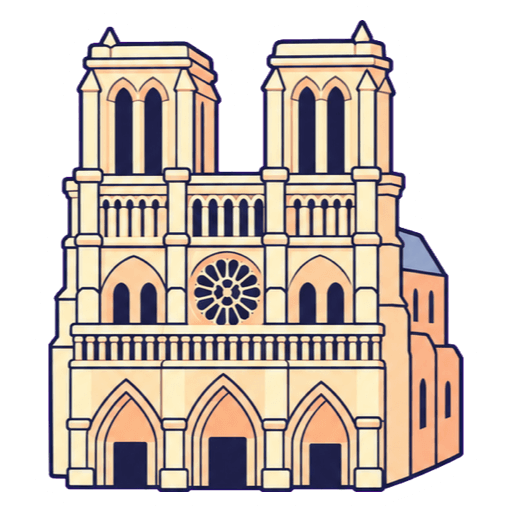
Gothic builders moved the bracing outside into open air. Walk behind the east apse of Notre-Dame Cathedral and you can trace slender stone flyers leaping across the lower aisle roofs to massive outer piers weighted down by carved stone pinnacles. With exterior piers absorbing the vault's outward thrust, the walls between them no longer carried the roof alone and opened up into fifteen-meter lancets of stained glass, as at Sainte-Chapelle two blocks away.
3. Rib vaults, rose windows, and working gargoyles
Look overhead inside a Gothic nave and you see diagonal stone rib vaults meeting at a carved center keystone; once masons wedged that top stone into place, compression locked the ribs together and the wooden scaffolding came down. Above the exterior doorways, circular frames branched into stone petals known as rose windows (distinct from earlier spoke-like wheel windows).
High along the gutters, carved monsters handled roof drainage. Rainwater running straight down soft limestone dissolves mortar in winter freezes, so masons hollowed stone spouts through the throats of gargoyles to pitch water clear of the buttresses below. Ledge creatures carved without water channels are grotesques or chimeras.
4. Town halls, guildhalls, and Gothic Revival towers
Medieval masons put pointed arches and rib vaults to work well beyond cathedrals: wool guildhalls in Flanders, civic palaces in Venice and Siena, university quads in Oxford, and fortified stone bridges in Prague all share the same structural kit. Five centuries later, nineteenth-century Gothic Revival architects dressed steel and brick civic landmarks in pointed lancets and stone tracery, from London's Elizabeth Tower and St Pancras Chambers to Budapest's riverside parliament. Browse all 38 building and style units in our sidewalk architecture field guide or check which historic cores pack the most sights per kilometer in the 45-Minute Walkable Heritage Index.
Test your eye with World School questions
Three quick visual checks pulled straight from the Gothic unit in Pandabout's World School:

World School · Gothic
Pick an answer to test your eye
0 of 3 answered
1. Why are round Gothic windows called rose windows?
Read the answer
When the stone tracery inside a circular window branches into petal-like segments, masons call it a rose window. Earlier round windows with straight, spoke-like bars are called wheel windows.
2. What separates a true gargoyle from a grotesque?
Read the answer
A true gargoyle carries an internal channel that throws rainwater clear of the masonry wall. Decorative stone creatures without water spouts are grotesques or chimeras.
3. What locks a Gothic stone rib vault in place once timber scaffolding comes down?
Read the answer
Masons laid diagonal stone ribs over temporary wooden centering. Once they wedged the central keystone into the crown of the arch, compression held the stone web upright and the timber frame came down.
Common questions
What is the quickest way to tell Gothic from Romanesque architecture?
Check the arches and wall thickness. Romanesque buildings rely on semicircular round arches, thick load-bearing masonry walls, and small deep-set windows. Gothic buildings combine pointed arches, exterior flying buttresses, ribbed ceiling vaults, and wide expanses of stained glass.
What is the difference between a gargoyle and a grotesque?
Plumbing. A true gargoyle has a carved stone or lead water channel running through its throat to throw roof runoff clear of the limestone walls below. Decorative monsters and ledge figures without water spouts are grotesques or chimeras.
How can you tell medieval Gothic from nineteenth-century Gothic Revival?
Medieval cathedrals often grew across two or three centuries, leaving mismatched spires, worn tool marks, and shifting window tracery styles. Nineteenth-century Gothic Revival landmarks like London's Palace of Westminster or St Pancras Chambers show machine-regular stonework, cast-iron roof frames, and planned symmetry.
How does World School work inside Pandabout?
Panko guides up to three short visual lessons a day across 38 units (114 lessons total) covering architectural styles and historic building types. All lessons ship inside the app for offline reading, and each unit ends with an optional field mission to catch a matching landmark nearby.
Collect the places you walk to.
Snap landmarks in person for drawn stickers, uncover map tiles block by block, and try World Pass free for 7 days.